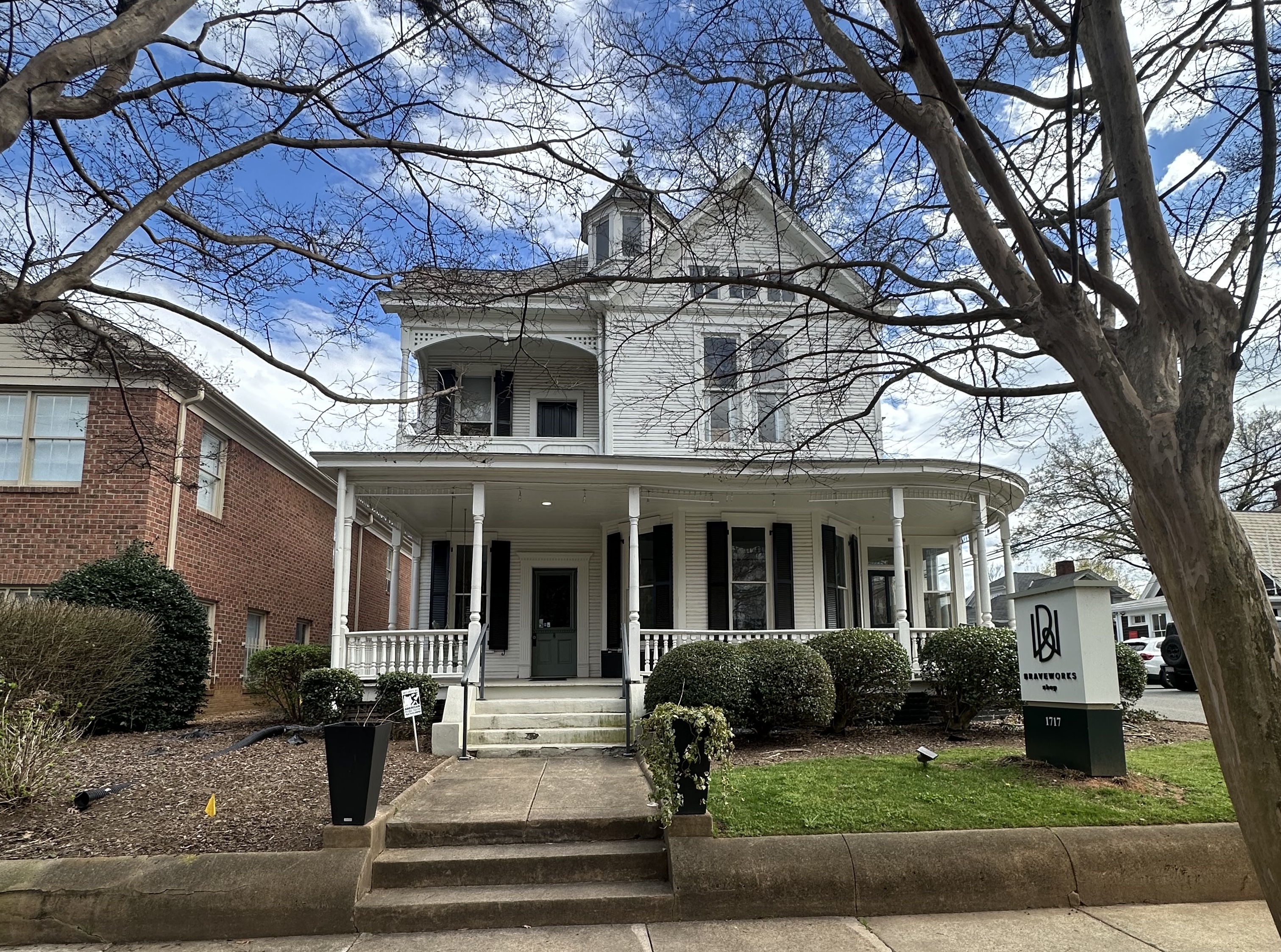
1717 Cleveland Avenue is a Queen Anne home in Dilworth, Charlotte's first streetcar suburb. Designated a historic property in 1986. The room has always belonged to people building things from a home office.
On September 18, 1900, the Charlotte Daily Observer reported that Mr. C. M. Scott would build a two-story, nine-room dwelling house on Cleveland Ave., Dilworth. "The roof will be of slate and the appointments up-to-date," the newspaper proclaimed.
Dilworth itself was nine years old at the time. Edward Dilworth Latta and his five associates in the Charlotte Consolidated Construction Company (the "Four C's") had opened the streetcar suburb on May 20, 1891. By the time Scott broke ground, electric trolleys ran the length of South Boulevard and the neighborhood was filling in with the first wave of Charlotte's professional class.
Scott's house was completed in May 1901.
Charles M. Scott (1858-1930) was a native of Ceres in Bland County, Virginia. He came to Charlotte to keep selling heavy machinery, drawn by the region's vigorous expansion. He set up shop on W. Fourth Street, where he managed the southern branch of Good Roads Machinery Co. and served as the local agent for the Ingersoll-Sergeant Drill Co.
He built the house with his wife, Idris Belle Repass Scott (1863-1934), and their four children: Jessie, Byron, Kenneth, and Wallace. The Scotts were members of Westminster Presbyterian Church on South Boulevard, two blocks east. C.M. served as a deacon. Idris led the women of the congregation.
Their son Byron Carlisle Scott (1896-1937) became a fixture of Charlotte's automobile business, first as an associate of C.C. Coddington and later as founder and president of Scott Buick Co. Their son Kenneth (1899-1918) was lost to the Spanish influenza epidemic in Chapel Hill at nineteen. Their oldest, Jessie, returned home after her own husband died and quietly rented rooms to boarders at 1717 Cleveland Ave. until her death in February 1946.
On May 4, 1946, Dr. Roy E. Hoke (a native of York, Pennsylvania) bought the house. He was an ordained Presbyterian minister with a Ph.D. in psychology from Johns Hopkins University, and had taught at Birmingham Southern College, Emory and Henry College, and Davidson College.
From this house, Dr. Hoke founded the Psychological Service Center, a private counseling enterprise. He kept his office in the home. He wrote a Sunday column in the Charlotte Observer from 1946 through 1959. He hosted a weekly program on Radio Station WBT through the 1950s. He served as a minister-at-large for local Presbyterian churches, substituting for ministers on vacation.
He was Phi Beta Kappa, a kind and compassionate man known for his sense of humor. He once remarked that "most Phi Beta Kappas die of pneumonia caused by holding the coat apart to show the key." He died on November 3, 1975. His widow Erma continued to live in the house.
From this house, the Scotts ran a heavy machinery sales territory. From this house, the Hokes ran a counseling practice and a radio show. The room has always belonged to people building things from a home office. On 1717 Cleveland Avenue
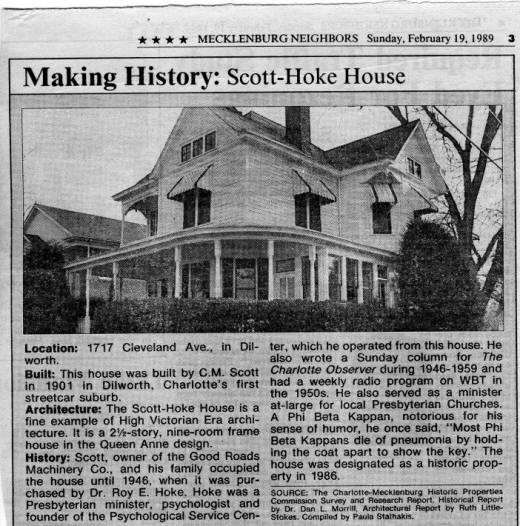
In July 1978, Dr. Dan L. Morrill of the Charlotte-Mecklenburg Historic Properties Commission prepared the official survey of the house, with an architectural description by Ruth Little-Stokes. The Commission found the structure and grounds in an excellent state of repair, well-preserved, with sufficient documentation to permit exterior restoration.
The Commission's case rested on three pillars. First, this is among the last houses of the Queen Anne style of architecture to be erected in Charlotte. Second, it is one of the oldest residences surviving in Dilworth, Charlotte's initial streetcar suburb. Third, it has associative ties with individuals of local prominence (the Scotts in industry; Dr. Hoke in psychology, ministry, and broadcasting).
The house was designated a Charlotte-Mecklenburg historic property in 1986.
One of the finest of the few remaining early houses constructed in Dilworth, Charlotte's first suburb. The extremely well-preserved Scott-Hoke House and its lovely landscaped grounds are an invaluable remnant of early Dilworth and a major neighborhood landmark. Ruth Little-Stokes, architectural historian, 1978
Ruth Little-Stokes catalogued the original 1900 finishes in her 1978 architectural report. Most of these are still here. A few worth pointing out next time you're on the porch.
The main parlor's hearth is bordered with scalloped sea shells and the fireplace surround is tiled in yellow flowers on a white background. Genuinely rare in Dilworth, where plain or varicolored tiles without figural design are typical.
The staircase rises in three flights against the outside wall, with massive paneled classical newels carrying rope moldings, applied sunburst patterns, and fluted urns. The urns have indentations in the center tops that suggest they may once have been lamp bases.
Centered on the front face of the roof, with three single-pane casement windows. The fish-scale slate turret has thick metal ribs and a metal cap. Originally surmounted by a finial that probably doubled as a lightning rod (long since removed).
A built-in china closet sits beside the dining room mantel, with glass doors that fold double to conserve space. The kind of detail you'd only build for someone who actually entertained.
An antique pecan tree shadows the back porch. It has been there longer than anyone can confirm.
Original brick basement under the kitchen and rear parlor, with an apparently original built-in storage cabinet and a coal chute. The coal is gone. The chute is still there.
After Dr. Hoke's death in 1975, the house passed through several stewards. Most recently it was home to BraveWorks, a nonprofit run by Michele and Eric Dudley that employed women rebuilding from abuse, making jewelry and other goods sold on-site.
When the Dudleys heard about the vision for a startup house in Charlotte, they said: "we want to figure out how to do this." The house already had purpose. We're keeping that going.
1717 Cleveland Avenue has been a heavy machinery sales office, a Presbyterian minister's counseling practice, a radio host's home studio, a nonprofit jewelry workshop, and now a startup house. The thread is the same. People building things, together, in a room they care about.

Apply for residency, catch the next House Jam, or walk the porch. The pecan tree is still there.